
HomeLearnInvesting in Dubai shares from India or Pakistan
How to invest in the Dubai stock market from India or Pakistan
 26 November 2026 · Amjad Hussain, ICWIM · Dubai, UAE
Many people in India and Pakistan follow Dubai-listed companies and wonder whether they can own shares on the Dubai Financial Market (DFM) without moving to the UAE. This guide explains how the process works, what you need, which costs and risks to understand, and why the rules of your home country matter as much as the rules in Dubai. It is education, not advice, and we do not tell you what to buy.
Can you invest from outside the UAE?
Yes, in principle. The depository that runs the investor-number system at DFM, Dubai Central Securities Depository (Dubai CSD), accepts applications from investors of any nationality, whether or not they live in the UAE. A non-resident applies with a valid passport. That is the Dubai side of the question.
The second side is your home country. India and Pakistan both regulate how residents move money abroad, and either may tax income earned from foreign shares. Those rules change, and they are separate from anything DFM publishes. A sensible order is: understand the home-country rules first, then the Dubai steps, then the costs, and only then think about which companies, if any, you want to learn about.
The steps, in order
- Check your home-country rules. In India, ask your bank or a tax adviser how the Liberalised Remittance Scheme and any reporting requirements apply to buying foreign-listed shares. In Pakistan, ask your bank or an adviser about State Bank of Pakistan foreign-exchange rules for individuals. Do not assume that a method that worked for a friend is allowed for you.
- Get a DFM investor number (NIN). It is free. You can apply through the DFM app, through DFM eServices, at the Dubai CSD desk on the trading floor, or through a licensed broker. Non-residents need a valid passport copy. If you want dividends paid by bank transfer, the depository asks for a bank statement or bank letter for an account in your own name.
- Choose a licensed broker. The investor number identifies you. A broker licensed on the exchange places your orders. Not every broker accepts clients who live abroad, so ask directly before you start.
- Complete the broker’s checks. Expect identity and address verification, questions about your source of funds, and a risk questionnaire. Documents issued outside the UAE, such as a power of attorney, may need to be certified or authenticated.
- Fund the account. Money usually moves by bank transfer in dirhams or another currency your broker accepts. Ask about transfer charges and about the exchange rate used.
- Learn how orders work before you place one: market and limit orders, trading hours and settlement. See how to buy shares on DFM and ADX for the step-by-step.
Documents you may be asked for
| Document | Why it is asked for | Tip |
|---|---|---|
| Passport (valid) | Identity for the investor number | Check the expiry date before you apply |
| National ID or address proof | Broker verification | Use recent documents that match your passport spelling |
| Bank statement or bank letter | Dividend payment by bank transfer; source of funds | The account must be in your own name |
| Power of attorney (if someone acts for you) | Allows a representative to apply | Foreign-issued ones need authentication; allow extra time |
| Tax identification number | Reporting and tax forms | Keep it handy for both countries |
What it can cost
The investor number is free. After that, costs sit mainly with the broker and the banks involved. Ask for a written fee schedule that lists:
- Brokerage commission per trade, often a percentage with a minimum fee.
- Exchange and clearing fees, which are usually added on top.
- Account or custody fees, if any.
- Bank transfer fees on both sides, plus the exchange-rate spread when you convert rupees into dirhams or another currency.
- Dividend handling fees and any tax withheld at source or due at home.
Small amounts can be eaten by fixed fees, so work out the total cost of a first purchase and a later sale before you begin. Our cost checklist for sending money shows how to compare transfer costs in the same way.
The risks to understand
- Market risk. Prices change every day, and you can lose some or all of the money you put in.
- Currency risk. The dirham is pegged to the US dollar, but your rupees are not. A move in the rupee against the dollar can change your result even when the share price is flat.
- Concentration risk. The Dubai market is smaller than the large global markets and is weighted toward banks, real estate and a few large companies. Owning a handful of shares is not diversified.
- Liquidity risk. Some listed companies trade thinly, so you may not be able to sell at the price you expect.
- Access risk. Time zones, trading hours (DFM trades on weekdays, in the morning and early afternoon UAE time) and broker rules for non-residents can limit what you can do and when.
- Rule risk. Capital controls, tax rules and reporting duties at home can change.
Tax and reporting: ask before you buy
The UAE does not charge personal income tax on dividends or capital gains for individuals, but that does not decide your tax position at home. A resident of India or Pakistan is generally taxed on worldwide income under local rules, and foreign assets can carry reporting duties. This guide does not give tax advice. Before you invest, ask a qualified tax adviser in your own country what to declare, what forms apply and how foreign dividends are treated.
Other ways people gain exposure
Buying shares directly is only one route. Some people prefer funds that hold a basket of companies, because a single fund is more diversified than a few shares. Others begin by learning in a paper-trading account, where no real money is at stake. If your home country limits direct foreign investment, products available locally, such as funds that invest internationally, may be easier to use. Compare the costs and the rules for each before you decide. Our index fund guide explains the idea of owning a whole market at once.
A worked example, with made-up numbers
Imagine someone in Karachi or Mumbai who has set aside the equivalent of AED 10,000 and is curious about Dubai shares. Before buying anything they list the costs they have been quoted: a transfer fee, an exchange-rate spread of about 1% and a broker minimum commission. They discover that, on this small amount, fixed charges would cost a noticeable share of their money, and that if the rupee strengthens against the dirham the value of their holding in rupees would fall even if the share price did not move. They also learn that dividends may be taxed at home. None of this means they should or should not invest. It means they now know the real, all-in cost and can decide with clear eyes. Real numbers will differ, so ask your own broker and bank.
Common mistakes
- Sending money through an informal channel that is not allowed in your country, or through a person you cannot verify.
- Using an unlicensed “broker” that promises easy profits. Check any firm on the regulator’s public lists, and read how to check if a broker is legal.
- Ignoring the exchange-rate and fee drag on small amounts.
- Buying because of a tip from a social media group.
- Putting all your savings into one market, one sector or one company.
- Forgetting that you must keep records for your tax return.
What to do next
Write down your goal, how long you can leave the money invested and how much you could lose without harm to your life. Then read the DFM investor FAQs and your own country’s rules, and speak with a licensed professional. If you want a structured path from basics to a plan you understand, see the one-to-one stock market programme, or book a free Fit Call to talk through whether it fits you. For a wider view of the options, visit where can I invest? Stocks.
Tools that make this easier
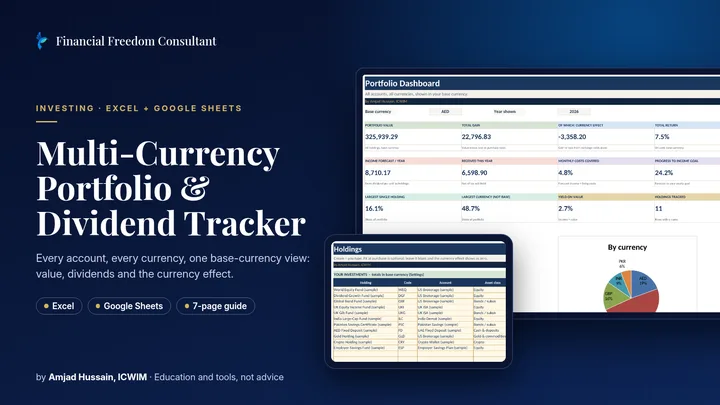 Multi-Currency Portfolio & Dividend Tracker$19, instant downloadView →
Frequently asked questions
Can an Indian or Pakistani resident get a DFM investor number?
Dubai CSD says investors of any nationality, including non-residents, can apply for an investor number using a valid passport. The number is free. Whether you may send money abroad to use it depends on your home-country rules.
Do I need to travel to Dubai?
DFM states personal presence is not required. You can apply through the DFM app or other official channels. A broker may ask for extra documents or certified copies, so check before you start.
Is the investor number the same as a trading account?
No. The number identifies you at the depository. You also need a trading account with a broker licensed on the exchange, and the broker must approve you.
Will I pay tax in Dubai on dividends?
The UAE does not charge personal income tax on dividends for individuals, but your home country may tax your worldwide income. Ask a qualified tax adviser where you live.
Is investing in Dubai shares safe?
No investment is risk-free. Prices move, currency changes can affect your result and a small market can be less diversified. Only invest money you can leave alone, and learn the basics first.
Can I buy through a friend or relative in the UAE?
A representative needs a properly authenticated power of attorney, and your home-country rules still apply to you. Do not hand money to someone informally without understanding the legal and tax consequences.
Sources
- Dubai CSD: issuing an investor number (NIN), individual account
- Dubai Financial Market: investor FAQs
- UAE Capital Market Authority
Want a person to check your numbers?
A free 15-minute intro call to see where you stand and what to do next. Education only, no tips, no pressure.
Short form first, so the call is useful for you.
Education only. Not investment, tax, legal or religious advice, and not a recommendation to buy, sell or hold any product. Rules and fees change; always check official sources. By Amjad Hussain, ICWIM (CISI Level 3 International Certificate in Wealth & Investment Management), accredited by the UAE Capital Market Authority, with 10+ years in financial markets. Dubai, UAE.