
HomeLearnGratuity on resignation vs termination
Gratuity on resignation vs termination in the UAE
 26 November 2026 · Amjad Hussain, ICWIM · Dubai, UAE
One of the most searched questions by UAE workers: “If I resign, do I lose my gratuity?” Here is the plain-English answer under the current labour law, with worked examples.
How gratuity is calculated now
Article 51 of the law sets the formula for full-time foreign workers in the private sector (mainland and most free zones):
- Less than 1 year of continuous service: no gratuity.
- Years 1 to 5: 21 days of basic wage for each year.
- After 5 years: 30 days of basic wage for each extra year.
- Part years count pro rata once you have completed one year.
- Unpaid absence days are not counted as service.
- Basic wage only (your last basic salary), not housing, transport or other allowances.
- Cap: the total cannot be more than two years’ wage.
The employer should pay all end-of-service dues within 14 days of the contract ending, and may lawfully deduct amounts you owe them.
Resignation vs termination: what changed
| Situation | Old law (1980), unlimited contracts | Current law (2021) |
|---|---|---|
| Resign after 1–3 years | One third of the gratuity | Full gratuity (21 days per year) |
| Resign after 3–5 years | Two thirds of the gratuity | Full gratuity |
| Resign after 5+ years | Full gratuity | Full gratuity |
| Terminated by employer | Full gratuity | Full gratuity |
So in normal cases, the reason you leave no longer changes the amount. What still matters is that you give proper notice (between 30 and 90 days, as your contract says) and that you are not dismissed for serious misconduct under Article 44, which is a special case you should check with MOHRE or a lawyer.
Worked examples
Example 1: resigning after 3 years
Basic salary AED 6,000. Daily wage = 6,000 ÷ 30 = AED 200. Gratuity = 21 days × 3 years × 200 = AED 12,600. Under the old unlimited-contract rule this would have been cut to one third (AED 4,200).
Example 2: terminated after 7 years
Basic salary AED 8,000. Daily wage = AED 266.67. First 5 years: 105 days. Next 2 years: 60 days. Total 165 days × 266.67 = AED 44,000. Resigning instead gives the same amount.
Example 3: leaving after 10 months
Less than one year of continuous service, so no gratuity is due, whether you resign or are let go.
Special cases
- Part-time workers get gratuity in proportion to the hours they actually work.
- Service before February 2022 under an old unlimited contract: ask MOHRE how that period is treated in your case.
- DIFC employees are covered by the DEWS savings plan, and ADGM has its own employment regulations; the mainland formula above may not apply.
- Government sector and UAE/GCC nationals follow different rules (nationals are usually covered by pension schemes).
- Alternative savings scheme: some private employers have joined the voluntary end-of-service savings scheme under Cabinet Resolution No. 96 of 2023, where monthly contributions are invested instead of a lump sum at the end.
How to check your final settlement
- Find your basic salary in your MOHRE contract, not your offer letter.
- Count your service from your first to last working day, minus unpaid days.
- Run the numbers in the gratuity calculator and print the result.
- Check the settlement also covers unpaid salary, unused annual leave and any notice-period pay.
- If it is wrong or late, raise it with HR in writing first, then file a complaint with MOHRE (app, website or 600 590 000).
Before you spend it
A gratuity is often the largest single sum an expat receives. Spend a week planning before you touch it: read what to do with your gratuity and see what it could grow to in the calculator’s second step.
Tools that make this easier
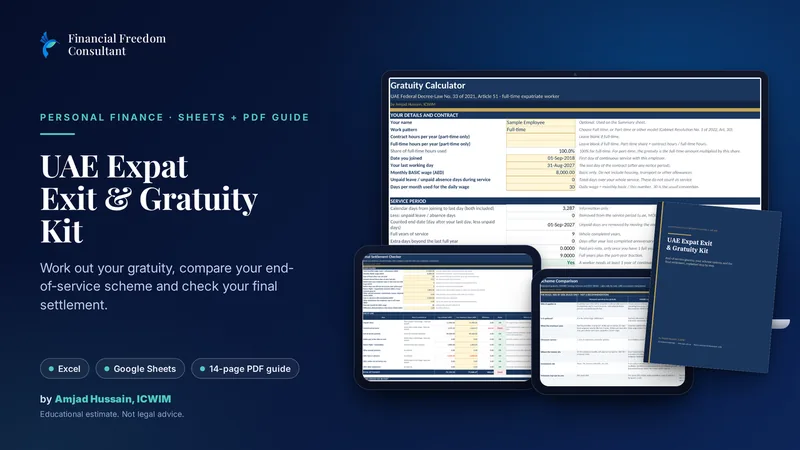 UAE Exit & Gratuity Kit$24, instant downloadView →
 Emergency Fund Planner$6.99, instant downloadView →Expat Budget & Remittance Planner$15, instant downloadView →
Frequently asked questions
Do I lose my gratuity if I resign in the UAE?
Not under the current law. Since Federal Decree-Law No. 33 of 2021 took effect in February 2022, a private-sector worker with at least one year of continuous service gets the same gratuity whether they resign or are terminated, provided they serve their notice period.
How many days of gratuity do I get per year?
21 days of basic wage for each of the first five years and 30 days for each year after that, based on your last basic salary, capped at two years' wage in total.
Is gratuity calculated on basic or gross salary?
On basic salary only. Housing, transport and other allowances are not included unless your contract says the basic includes them.
When must my employer pay my gratuity?
The law requires end-of-service dues to be paid within 14 days of the end of the employment relationship.
Do I get gratuity if I worked less than one year?
No. Gratuity starts only after one full year of continuous service.
Sources
- UAE Federal Decree-Law No. 33 of 2021 on the Regulation of Labour Relations (Articles 43, 44, 51, 53)
- UAE Government portal: End of service benefits
- MOHRE
Want a person to check your numbers?
A free 15-minute intro call to see where you stand and what to do next. Education only, no tips, no pressure.
Short form first, so the call is useful for you.
Education only. Not investment, tax, legal or religious advice, and not a recommendation to buy, sell or hold any product. Rules and fees change; always check official sources. By Amjad Hussain, ICWIM (CISI Level 3 International Certificate in Wealth & Investment Management), accredited by the UAE Capital Market Authority, with 10+ years in financial markets. Dubai, UAE.