
HomeLearnHow to invest in US stocks from the UAE
How to invest in US stocks from the UAE
 26 November 2026 · Amjad Hussain, ICWIM · Dubai, UAE
Many UAE residents want a share of the world’s largest stock market. It is possible, but there are details beginners miss: which broker, which tax form, how dividends are taxed, what happens to US assets when you die, and what the dollar peg means. This guide covers the essentials in plain English.
Three routes to US stocks
| Route | How it works | Watch-outs |
|---|---|---|
| UAE-licensed broker with US market access | Open an account with a broker licensed in the UAE that offers US shares | Check the licence, fees, minimums, and where your shares are held |
| International broker | A global broker serving residents of many countries | Check whether it can serve UAE residents, which regulator covers your account and what protections apply |
| Funds | Buy a fund or ETF that holds US shares, instead of single stocks | Check fees, domicile of the fund and how it is taxed |
Whichever route you choose, verify the firm first. Our guide to checking if a broker is legal sets out the steps, including checking the regulator’s register and confirming the entity that holds your money.
Step by step
- Fix the basics first. Build an emergency fund and clear expensive debt. Money you may need in the next few years should not be in shares.
- Choose and check a broker. Compare commissions, currency conversion charges, platform quality, minimums, and withdrawal speed and fees.
- Open the account. You will provide your ID, proof of address and details about your experience. Be honest about your goals and risk tolerance.
- Complete Form W-8BEN. This tells the broker you are not a US person for tax. Without it, withholding can be higher.
- Fund the account from a bank account in your own name, in the way the broker allows.
- Place your first order. Use a limit order if you want to control the price, and understand that US markets trade in New York time, which is during the UAE evening.
- Keep records of every trade, dividend and statement.
Tax: the part beginners miss
Dividends are normally taxed at 30% at source
US companies withhold tax on dividends paid to non-US investors. The standard rate is 30%. Some countries have tax treaties with the US that reduce this rate, but the US does not have an income-tax treaty with the UAE, so you should expect the standard rate on ordinary dividends. Check the current position on the IRS website or with a tax professional, as rules and special cases (for example certain fund distributions) change.
Capital gains
Non-resident aliens are generally not taxed by the US on gains from selling shares, apart from certain exceptions, but your home country may tax your gains. The UAE does not charge personal income tax on investment income for individuals, so the result depends heavily on where you are a tax resident and a citizen.
US estate tax for non-residents
Shares in US companies are treated as US-situs assets. A non-resident who owns more than a threshold amount of US assets at death may need to file a US estate tax return, and tax can apply to the part above a small exemption. The filing threshold is much lower than the exemption available to US citizens. For anyone planning to hold a large US stock portfolio directly, it is worth asking an adviser about this. Holding a fund domiciled outside the US, or using a different structure, changes the position, but it brings its own questions.
These are broad outlines and not tax advice. Your own nationality, residence and family situation matter, so ask a qualified tax adviser before you commit large amounts.
Currency: the dirham and the dollar
The UAE dirham has long been pegged to the US dollar, so for a UAE resident whose spending is in dirhams, US dollar investments carry little exchange-rate risk today. That can change if you earn or plan to spend in another currency, such as the Indian rupee, Pakistani rupee or pound. If you will eventually move home, the exchange rate between the dollar and your home currency can affect your result as much as the share prices. Think about the currency you will spend in later. Our retirement guide for UAE expats explains why.
Costs to compare
- Commission per trade, or a fixed monthly fee.
- Currency conversion margin when you move dirhams to dollars and back.
- Account, inactivity and custody fees.
- Fund fees if you buy ETFs or funds.
- Withdrawal and bank transfer charges.
Small fees compound over decades. Add them up before you decide.
Common mistakes
- Buying a few famous stocks and calling it diversified. A few large technology shares can fall together.
- Ignoring tax until the end. Dividends are taxed at the source, so the net income may be lower than expected.
- Trading on tips and social media. Hype is not research.
- Using leverage or options as a beginner. They can lose more than you invest.
- Not keeping records or a will. Your family needs to know the accounts exist.
Learn the skill, not just the steps
Opening an account is easy. Choosing what to own, how much, and how to stay calm when markets fall is the real work. In Amjad’s one-to-one Stock Market Mentor programme, you learn how companies are valued, how funds work, how to build a diversified practice portfolio and how to manage risk. It is education only, with no stock tips. See also Where can I invest? Stocks and ETFs and index funds, or book a free 15-minute intro call.
Tools that make this easier
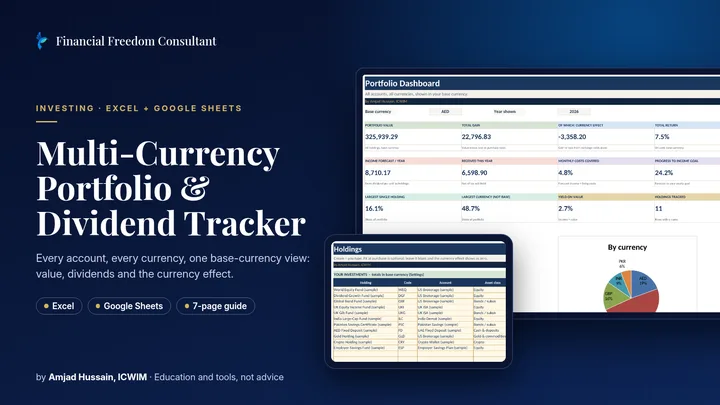 Multi-Currency Portfolio & Dividend Tracker$19, instant downloadView →Stock Market Foundations Workbook$9.99, instant downloadView →Stock Market Education Bundle$18.99, instant downloadView →
Frequently asked questions
Can I invest in US stocks from the UAE?
Yes, through a licensed broker that offers US markets. Check the broker's licence and which entity holds your account before you fund it.
What is a W-8BEN form?
It is a US tax form that tells your broker you are a non-US person. You usually complete it when opening an account that can hold US shares.
How much tax do I pay on US dividends as a UAE resident?
US dividends are normally withheld at 30% at source for UAE residents, because there is no US-UAE income tax treaty. Check the current rules with the IRS or a tax adviser.
Does the UAE tax my US stock gains?
The UAE does not charge personal income tax on investment gains for individuals, but your home country may tax them and the US has its own rules for non-residents.
What is US estate tax for non-residents?
US company shares are US-situs assets. If you own more than a threshold amount at death, your estate may need to file a US return, and tax can apply above a small exemption. Ask a tax adviser.
Is the dirham pegged to the dollar?
Yes, the dirham has long been pegged to the US dollar, so exchange-rate risk is small for dirham spending, but it matters if you will spend in another currency.
Is it better for a beginner to buy a fund than single US stocks?
Many beginners prefer a diversified fund because it spreads risk across many companies. Check the fund's fees, domicile and how it is taxed.
Sources
- IRS: Instructions for Form W-8BEN
- IRS: Some nonresidents with U.S. assets must file estate tax returns
- IRS Publication 515: Withholding of tax on nonresident aliens
- UAE Capital Market Authority
Want a person to check your numbers?
A free 15-minute intro call to see where you stand and what to do next. Education only, no tips, no pressure.
Short form first, so the call is useful for you.
Education only. Not investment, tax, legal or religious advice, and not a recommendation to buy, sell or hold any product. Rules and fees change; always check official sources. By Amjad Hussain, ICWIM (CISI Level 3 International Certificate in Wealth & Investment Management), accredited by the UAE Capital Market Authority, with 10+ years in financial markets. Dubai, UAE.