
Index fund vs ETF: what is the difference?
 26 November 2026 · Amjad Hussain, ICWIM · Dubai, UAE
Both can track the same index at low cost, so what is actually different? Here is a clear comparison, plus the domicile question most expat guides skip.
Side-by-side comparison
| Index mutual fund | Index ETF | |
|---|---|---|
| How you buy | From the fund company or a fund platform | Through a broker, on a stock exchange |
| Price | Once a day (net asset value) | Live during market hours |
| Minimum | Set by the fund; can be small for monthly plans | Price of one share (or less where fractional shares exist) |
| Monthly automatic investing | Usually easy (SIP) | Depends on the broker |
| Costs to check | Expense ratio, any entry or exit load | Expense ratio, broker commission, bid-ask spread |
| Best for | Set-and-forget monthly investors | Investors with a broker account who want flexibility |
Costs: the number that matters most
The expense ratio (or ongoing charge) is taken every year. On a long horizon, small differences add up: on 100,000 over 25 years at a 7% gross return, a 0.2% fee leaves you with far more than a 1.5% fee, often a difference of tens of thousands. Try different returns in the SIP calculator to feel the effect.
The expat question: where is the fund based?
For investors who are not US citizens or residents, the fund’s domicile (where it is legally based) can matter as much as its fee:
- US-listed ETFs: dividends paid to non-US investors usually have US withholding tax taken off (30% where no tax treaty lowers it). US-situs assets above a modest threshold can also be exposed to US estate tax for non-US persons.
- Ireland-domiciled (UCITS) ETFs tracking US shares often suffer a lower 15% withholding on US dividends at fund level under the US–Ireland treaty, and are not US-situs assets for the investor. Many expats use them for this reason.
- Accumulating vs distributing: accumulating funds reinvest dividends automatically, which suits long-term investors; distributing funds pay them out.
- US citizens are the exception: non-US funds can trigger harsh “PFIC” tax rules, so they usually stay with US-domiciled funds. Get tax advice.
Rules change and depend on your situation; check with a qualified tax adviser before you choose.
How to choose in 5 questions
- Which index? A broad global or large-market index gives wide diversification.
- What is the total yearly cost? Lower is usually better for the same index.
- Where is it domiciled, and is it accumulating or distributing?
- How will you invest? Monthly automatic plan (often easier with mutual funds) or buying shares yourself (ETFs).
- Is the platform regulated? Check the broker before you open an account.
Three myths
- “ETFs are riskier.” The risk comes from what the fund holds, not its wrapper. An S&P 500 ETF and an S&P 500 mutual fund carry the same market risk.
- “Index funds can’t lose money.” They fall when the market falls.
- “Trading ETFs often is better.” Frequent trading usually adds costs and mistakes. Buy regularly and hold.
Tools that make this easier
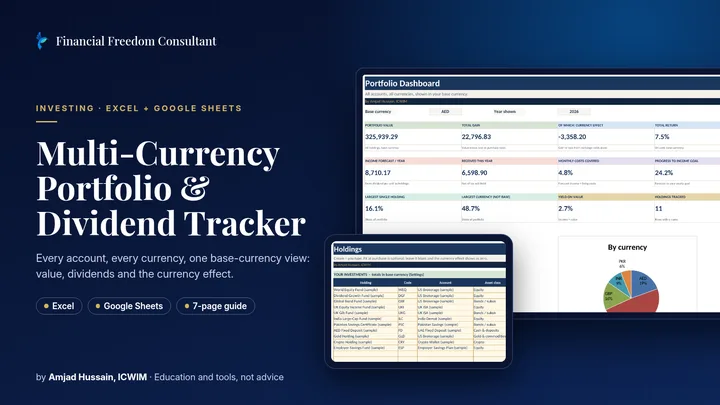 Multi-Currency Portfolio & Dividend Tracker$19, instant downloadView →Stock Market Foundations Workbook$9.99, instant downloadView →Stock Market Education Bundle$18.99, instant downloadView →
Frequently asked questions
Is an index fund the same as an ETF?
Not exactly. An index fund is any fund that tracks an index, and it can be a mutual fund or an ETF. ETFs trade on an exchange during the day; index mutual funds are bought from the fund company at one end-of-day price.
Which is cheaper, an index fund or an ETF?
Both can be very cheap. Compare the expense ratio plus, for ETFs, broker commissions and the bid-ask spread, and for mutual funds any entry or exit loads.
Should expats buy US-listed or Ireland-domiciled ETFs?
Many non-US expats prefer Ireland-domiciled UCITS ETFs because of lower US dividend withholding at fund level and to avoid holding US-situs assets that may face US estate tax. US citizens usually need US-domiciled funds. Get tax advice for your situation.
Can I do a monthly SIP in an ETF?
Some brokers offer automatic monthly ETF plans; others need you to buy manually each month. Index mutual funds usually make automatic monthly investing easier.
What is an accumulating ETF?
An accumulating (Acc) fund reinvests dividends inside the fund instead of paying them out, so your investment compounds automatically. A distributing (Dist) fund pays dividends to you.
Sources
- US SEC Investor.gov: Index funds
- US SEC Investor.gov: Exchange-traded funds
- IRS: Foreign persons, withholding on US-source income
- IRS: Estate tax for nonresidents not citizens of the US
Want a person to check your numbers?
A free 15-minute intro call to see where you stand and what to do next. Education only, no tips, no pressure.
Short form first, so the call is useful for you.
Education only. Not investment, tax, legal or religious advice, and not a recommendation to buy, sell or hold any product. Rules and fees change; always check official sources. By Amjad Hussain, ICWIM (CISI Level 3 International Certificate in Wealth & Investment Management), accredited by the UAE Capital Market Authority, with 10+ years in financial markets. Dubai, UAE.