
HomeLearnHow to start investing in the UAE
How to start investing in the UAE as an expat
 26 November 2026 · Amjad Hussain, ICWIM · Dubai, UAE · Updated 29 November 2026
Good salary, no income tax, and still not investing? You are not alone. This guide explains how investing works for expats in the UAE and gives you a simple 7-step plan to start safely.
Who regulates investing in the UAE
| Regulator | Covers |
|---|---|
| UAE Capital Market Authority (formerly the Securities and Commodities Authority, SCA; renamed on 1 January 2026) | Securities, funds and brokers onshore, including the ADX and DFM exchanges |
| Dubai Financial Services Authority (DFSA) | Firms in the Dubai International Financial Centre (DIFC) |
| Financial Services Regulatory Authority (FSRA) | Firms in Abu Dhabi Global Market (ADGM) |
| Central Bank of the UAE | Banks, insurance and payments |
| Virtual Assets Regulatory Authority (VARA) | Crypto firms in Dubai (outside the DIFC) |
A firm must be licensed for the exact activity it offers you. Here is how to check: how to check if a broker is legal.
Tax basics (and the trap most expats miss)
- The UAE does not currently charge personal income tax, and personal investment income of individuals is generally not taxed in the UAE. Corporate tax (since 2023) is aimed at businesses.
- Your home country may still tax you. US citizens are taxed on worldwide income wherever they live and face extra rules on non-US funds. UK, Indian, Pakistani and Canadian rules depend on your residence status, which can change when you move home.
- Where a fund is based (its “domicile”) affects tax on dividends and, for US-listed holdings, possible US estate tax for non-US persons. See index fund vs ETF.
Your main options
1. UAE shares on ADX and DFM
You open an account with a licensed local broker and get an investor number (NIN) from the exchange. Good for owning UAE companies and dividends, but a small market to put all your eggs in.
2. International brokers and ETFs
DFSA- or FSRA-licensed brokers, and large international brokers, give access to global ETFs and shares. This is how many expats build a diversified, low-cost portfolio.
3. Home-country investing
Many Indians invest in Indian mutual funds through NRE/NRO accounts; many Pakistanis use a Roshan Digital Account. Useful if you will retire at home, but it concentrates your money in one country and currency.
4. Bank and adviser products
Be careful with long-term “savings plans” and investment-linked insurance sold on commission. Some lock you in for 10 to 25 years with high fees and large charges if you stop early. Always ask for the total yearly cost and the exit charges in writing.
5. Shariah-compliant choices
Islamic equity funds, Shariah-screened ETFs and sukuk are widely available. Check the fund’s Shariah board and its costs like any other fund. For zakat on your investments, use the zakat calculator.
A 7-step plan to start
- Write down the goal and the date: home deposit in 5 years, children’s university in 12, retirement in 25.
- Build an emergency fund of several months of essentials: emergency fund calculator.
- Clear high-interest debt: debt payoff calculator.
- Pick the currency you will spend in later, and invest mostly in that or in a broad global mix.
- Choose a regulated platform with low fees and check its licence yourself.
- Start with diversified, low-cost funds, such as a global index fund or ETF: what is an index fund?
- Automate a monthly amount on payday and raise it every year: see the SIP calculator.
Red flags to walk away from
- “Guaranteed” monthly returns, especially from forex or crypto “account managers”.
- Pressure to decide today, or to pay into a personal account.
- Contacts through WhatsApp or Telegram groups offering signals.
- An adviser who will not tell you how they are paid.
Tools that make this easier
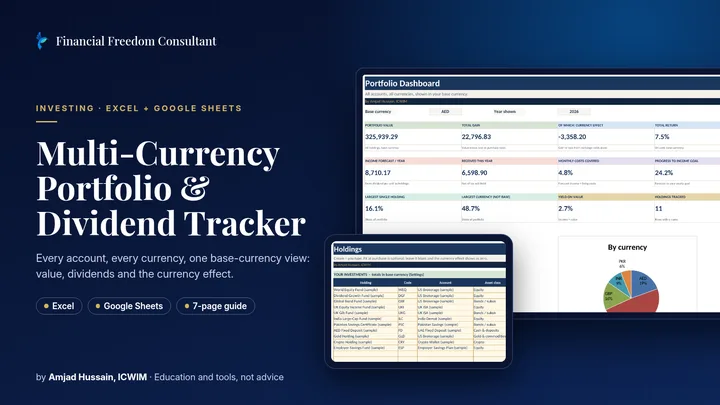 Multi-Currency Portfolio & Dividend Tracker$19, instant downloadView →Stock Market Foundations Workbook$9.99, instant downloadView →
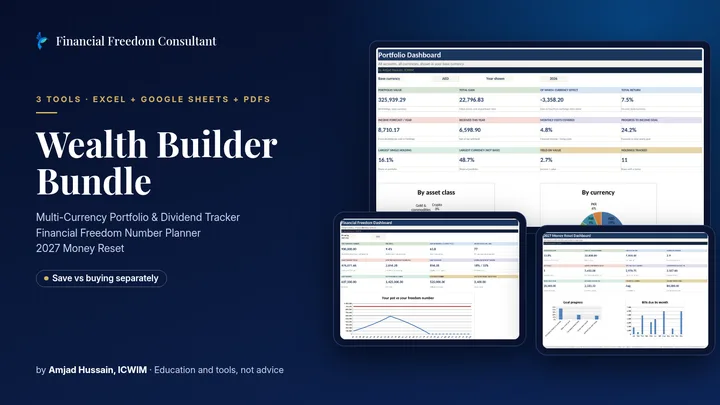 Wealth Builder Bundle: Portfolio Tracker + Freedom Number Planner + 2027 Year-End Money Plan$28.80 until 31 Dec (list $36), instant downloadView →
Frequently asked questions
Can expats invest in the UAE stock market?
Yes. Expats can open an account with a licensed broker and get an investor number (NIN) to trade shares on the Abu Dhabi Securities Exchange (ADX) and Dubai Financial Market (DFM).
Do I pay tax on investments in the UAE?
The UAE does not currently charge personal income tax, and an individual's personal investment income is generally not taxed in the UAE. Your home country may still tax you, especially if you are a US citizen, so check your own position.
Who regulates brokers in the UAE?
Onshore securities firms are regulated by the UAE Capital Market Authority (formerly the SCA). Firms in the DIFC are regulated by the DFSA and firms in ADGM by the FSRA. Crypto firms in Dubai fall under VARA.
How much money do I need to start investing?
Many brokers and funds let you start with a small monthly amount. What matters more is having an emergency fund first and investing regularly at low cost.
Are expat savings plans a good idea?
Some are expensive and inflexible, with high yearly charges and big penalties if you stop early. Ask for the total yearly cost and exit charges in writing and compare with low-cost index funds before signing.
How should I invest my first 10,000 AED in the UAE?
There is no single right answer, but the usual education order is: build an emergency fund first, clear expensive debt, then learn how a diversified, low-cost fund such as a broad index fund or ETF works before buying through a broker licensed by a UAE regulator. Avoid anyone who promises fixed or guaranteed returns. This is education, not a recommendation.
Sources
- UAE Capital Market Authority: the new law (renaming of the SCA from 1 January 2026)
- UAE Government portal: Financial markets
- DFSA public register
- FSRA (ADGM)
- UAE Ministry of Finance: Corporate tax
Want a person to check your numbers?
A free 15-minute intro call to see where you stand and what to do next. Education only, no tips, no pressure.
Short form first, so the call is useful for you.
Education only. Not investment, tax, legal or religious advice, and not a recommendation to buy, sell or hold any product. Rules and fees change; always check official sources. By Amjad Hussain, ICWIM (CISI Level 3 International Certificate in Wealth & Investment Management), accredited by the UAE Capital Market Authority, with 10+ years in financial markets. Dubai, UAE.