
 By Amjad Hussain, ICWIM · Accredited by the UAE Capital Market Authority · Updated 26 November 2026
What is a SIP?
A SIP (systematic investment plan) means investing a fixed amount at regular intervals, usually monthly, into a fund or a basket of shares. In the US and UK the same habit is called dollar-cost averaging or a regular investment plan. Because you buy every month, you buy more units when prices are low and fewer when prices are high, and you never have to guess the “right time”.
The formula behind the calculator
For a fixed monthly amount P, a monthly rate i (the yearly rate ÷ 12) and n months, with each payment made at the start of the month:
Future value = P × [((1 + i)n − 1) ÷ i] × (1 + i)
A starting lump sum grows as Lump × (1 + i)n. With a step-up, the monthly amount rises once a year, so the calculator works month by month rather than with one formula.
Worked example
2,000 a month for 15 years at 8% a year puts in 360,000 and could grow to roughly 700,000. Add a 5% yearly step-up and you put in about 518,000 and could end near 930,000, roughly 236,000 more than the flat plan.
Compound interest in one sentence
Your returns start earning returns. That is why time in the market usually matters more than the exact fund you pick, and why the calculator shows what waiting five years would cost.
How to start a SIP as an expat
- Build a small emergency fund first (emergency fund calculator).
- Clear high-interest debt such as credit cards (debt payoff calculator).
- Choose a regulated platform. Indians abroad usually invest in Indian mutual funds through an NRE or NRO account and the fund’s KYC process; Pakistanis abroad often use a Roshan Digital Account; others use an international broker. Always check the broker is legal.
- Prefer low-cost, diversified funds; see index fund vs ETF.
- Automate the monthly transfer on payday and step it up with each pay rise.
Go further with a ready-made planner
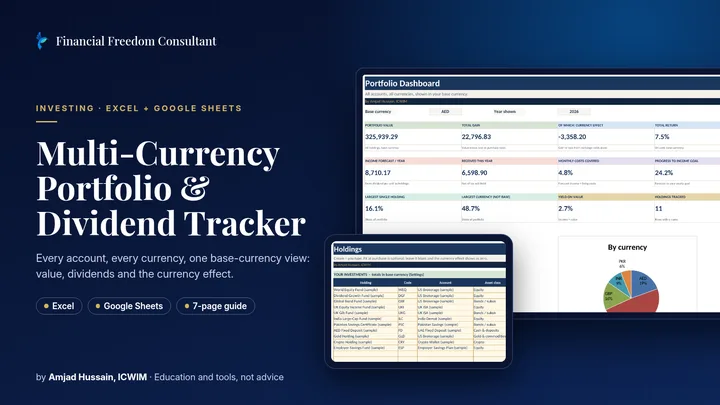 Multi-Currency Portfolio & Dividend Tracker$19, instant downloadView →
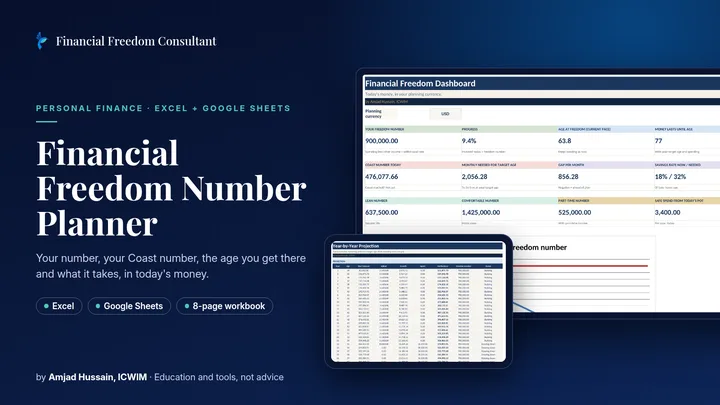 Financial Freedom Number Planner$17, instant downloadView →Stock Market Foundations Workbook$9.99, instant downloadView →
Frequently asked questions
How does a SIP calculator work?
It assumes you invest the same amount every month at a fixed yearly return, compounds it monthly and adds up every contribution. The result is an estimate, because real returns change every year.
What is a step-up SIP?
A step-up (or top-up) SIP raises your monthly amount by a set percentage each year, for example 10%, usually in line with pay rises. It can make a large difference to the final value.
Is a SIP better than a lump sum?
A lump sum invested early has historically often ended higher because more money is invested for longer, but a SIP spreads your entry over time and suits people who invest from monthly income. Many people do both.
What return should I assume?
There is no right number. Try a cautious, middle and hopeful rate, such as 5%, 8% and 10%, and plan around the cautious one. Returns are never guaranteed and can be negative.
Can NRIs and overseas Pakistanis start a SIP from the UAE?
Many can, through the routes their home regulator allows, such as NRE/NRO accounts for Indian mutual funds or a Roshan Digital Account for Pakistan. Rules for residents of some countries (for example the US and Canada) are stricter, so check with the fund house.