
 By Amjad Hussain, ICWIM · Accredited by the UAE Capital Market Authority · Updated 26 November 2026
How this FIRE calculator works
FIRE stands for Financial Independence, Retire Early. The idea is simple: build an invested pot large enough that a small, steady yearly withdrawal can pay for your life, so work becomes a choice.
- Your FIRE number = the yearly spending your investments must cover ÷ your withdrawal rate. At 4%, that is 25 times your yearly spending. At 3.5% it is about 28.6 times, and at 3% about 33.3 times.
- Your timeline: the calculator grows today’s savings and your monthly investing at a real return (your assumed return minus inflation), month by month, until the pot reaches the FIRE number.
- Lump sums: if you expect a gratuity, a bonus or a property sale, add it in the year you expect it.
Worked example
Spending of 120,000 a year at a 4% withdrawal rate gives a FIRE number of 3,000,000. With 100,000 invested today, 5,000 invested every month and a 7% return with 3% inflation (about 3.9% real), the pot reaches 3,000,000 in about 26 years. Invest a quarter more each month and the date moves more than three years closer. That is the main lesson of FIRE: your savings rate matters more than any single investment choice.
Want to go deeper, with Coast FIRE, a two-country plan and the monthly amount needed to retire at the age you choose? The Financial Freedom Number Planner (Excel and Google Sheets) does it all in today’s money.
Why expats need their own FIRE plan
- No state pension in most host countries. In the UAE, for example, the federal pension system covers UAE and GCC nationals; most foreign workers receive an end-of-service gratuity instead, which is a one-off lump sum, not an income for life. Check your own gratuity with the UAE gratuity calculator.
- Two currencies. Many expats earn in one currency and plan to retire in another. Do this calculation in the currency you will spend in, and remember that exchange rates can move a lot over 20 years.
- A different cost of living at the end. Moving home to Pakistan, India or elsewhere can cut your spending, while staying in Dubai or moving to the UK can raise it. Run the calculator for each option.
- Health cover. Employer health insurance usually ends with the job. Put a realistic premium in your retirement spending.
Where the 4% rule comes from, and its limits
The 4% rule grew out of research by US financial planner William Bengen (1994) and the later “Trinity study”, which looked at how much could be withdrawn from a US stock and bond portfolio, rising with inflation, without running out over 30 years of historical markets. It is useful as a rule of thumb, but it is based on US history, assumes a 30-year retirement and ignores fees and taxes. If you plan to stop work in your 30s or 40s, many planners test 3% to 3.5% instead.
Five ways to reach your FIRE number sooner
- Raise your savings rate first. Every pay rise is a chance to invest part of it.
- Keep investment costs low. A 1% yearly fee can take a large share of your final pot over 25 years; see index fund vs ETF.
- Do not spend your gratuity. Read what to do with your gratuity.
- Clear high-interest debt before investing heavily; use the debt payoff calculator.
- Keep a separate emergency fund so a job loss does not force you to sell investments at a bad time; size it with the emergency fund calculator.
Go further with a ready-made planner
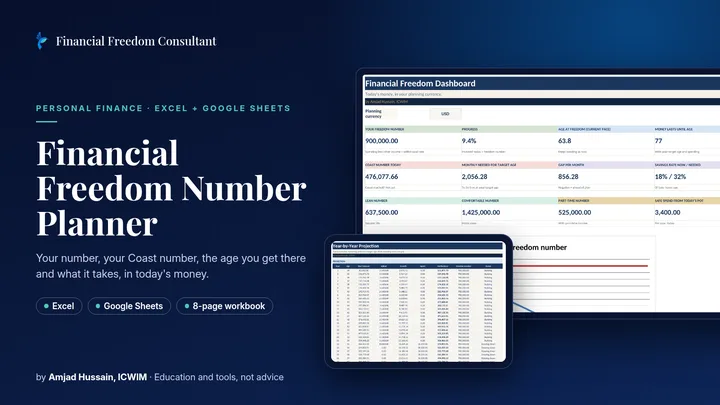 Financial Freedom Number Planner$17, instant downloadView →
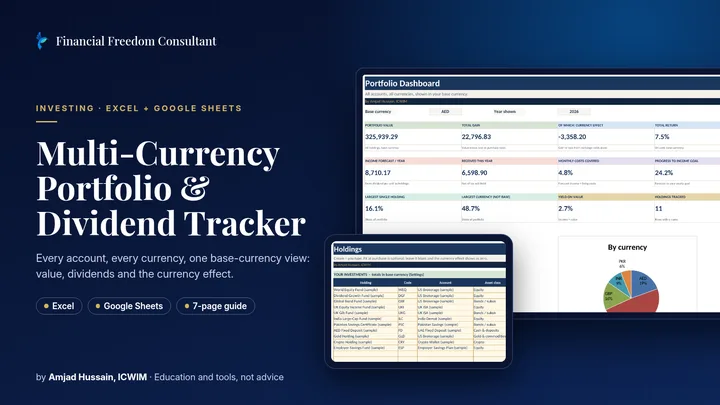 Multi-Currency Portfolio & Dividend Tracker$19, instant downloadView →
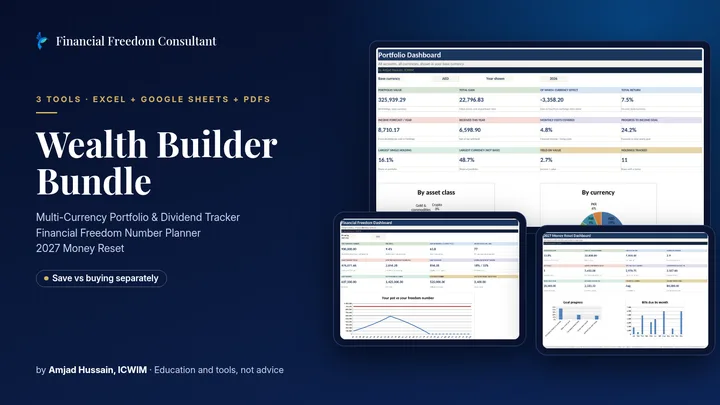 Wealth Builder Bundle: Portfolio Tracker + Freedom Number Planner + 2027 Year-End Money Plan$28.80 until 31 Dec (list $36), instant downloadView →
Frequently asked questions
What is a FIRE number?
Your FIRE number is the size of invested pot that could cover your yearly spending through withdrawals. A common way to estimate it is yearly spending divided by a safe withdrawal rate, such as 4%, which equals 25 times your yearly spending.
Is the 4% rule safe for early retirement?
It is a rule of thumb based on US market history over 30-year periods. For retirements longer than 30 years, or if you want more margin, many planners use 3% to 3.5%. No withdrawal rate is guaranteed.
How much do I need to retire as an expat?
Start from what you expect to spend each year in the country where you will live, in that currency, including health cover. Subtract any guaranteed income such as rent or a pension, then divide by your withdrawal rate. This calculator does that and shows how long it could take.
Should I include my gratuity in my FIRE plan?
Yes, if you plan to invest it rather than spend it. Enter it as a lump sum in the year you expect to receive it. Remember it is paid once; it is not a pension.
Does this calculator account for inflation?
Yes. It converts your assumed return into a real return (after inflation) and shows every figure in today's money, so your FIRE number keeps its buying power.