
 By Amjad Hussain, ICWIM · Accredited by the UAE Capital Market Authority · Updated 26 November 2026
How to use this zakat calculator
- Set the nisab. Enter today’s price per gram of gold and silver and pick your basis: 85 g of gold or 595 g of silver.
- List what you own on your zakat date: cash, gold, silver, investments, money owed to you and business stock.
- Take off what you owe now. Debts and bills that are due.
- Pay 2.5% of the net amount if it is at or above the nisab and you have held wealth at or above the nisab for a full lunar year (hawl).
How zakat on shares works
Shares are the part most calculators get wrong, because the answer depends on why you hold them.
- Shares you bought to sell (trading): treated like trade goods, so zakat is 2.5% of the full market value on your zakat date.
- Shares you hold for the long term (dividends or growth): zakat is due on your share of the company’s zakatable assets (cash, receivables, stock for sale), not on the factory, brand and buildings. AAOIFI Shari’ah Standard No. 35 on Zakat allows this share to be estimated when the exact figure is not available.
Because few people can read every company’s balance sheet, zakat bodies publish a proxy:
| Method | What you pay on a 10,000 long-term portfolio | Who uses it |
|---|---|---|
| 25% proxy | 10,000 × 25% × 2.5% = 62.50 | National Zakat Foundation (UK), based on its review of FTSE 100 balance sheets |
| 30% proxy | 10,000 × 30% × 2.5% = 75 | NZF Canada’s calculator |
| Full value | 10,000 × 2.5% = 250 | Cautious approach, and the rule for trading shares |
| Company accounts | Your exact zakatable assets per share × shares × 2.5% | Most precise; some Shariah-screening apps show it |
For mutual funds and ETFs, the same logic applies: if you trade them, use full value; if you hold them long term, look at what the fund holds. A cash or sukuk fund is mostly zakatable; an equity index fund can use the share method. Read the full guide: zakat on shares, funds and ETFs.
Worked example
Cash 20,000; long-term ETF portfolio 60,000 using the 25% proxy (= 15,000); trading shares 5,000; a credit card bill of 3,000 due. Net zakatable wealth = 20,000 + 15,000 + 5,000 − 3,000 = 37,000. If that is above the nisab, zakat = 37,000 × 2.5% = 925.
Good habits for investors
- Pick one zakat date (many people use a date in Ramadan) and take a screenshot of your account values that day.
- Keep a simple record of which holdings are “trading” and which are “long term”, so you apply the same method every year.
- Track your wealth across currencies in one place; the Net Worth Tracker makes the yearly zakat snapshot quick.
- Check that your broker is regulated before you invest: how to check if a broker is legal.
Sources: National Zakat Foundation (UK), “Zakat on stocks and shares” and “Zakat on share investments: determining a proxy” (nzf.org.uk); NZF Canada zakat calculator (nzfcanada.com); AAOIFI Shari’ah Standard No. 35 (Zakat), art. 4/2/4. Checked 26 November 2026.
Go further with a ready-made planner
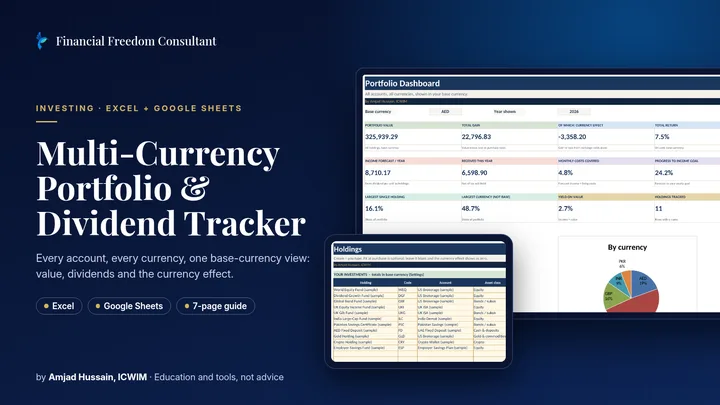 Multi-Currency Portfolio & Dividend Tracker$19, instant downloadView →
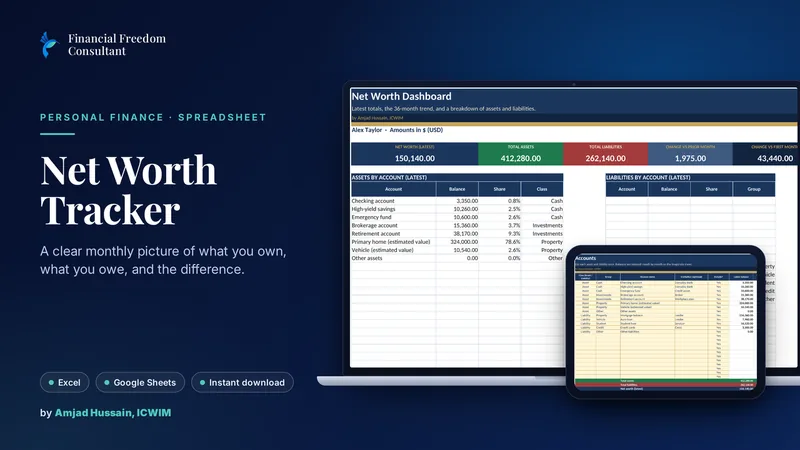 Net Worth Tracker$6.99, instant downloadView →
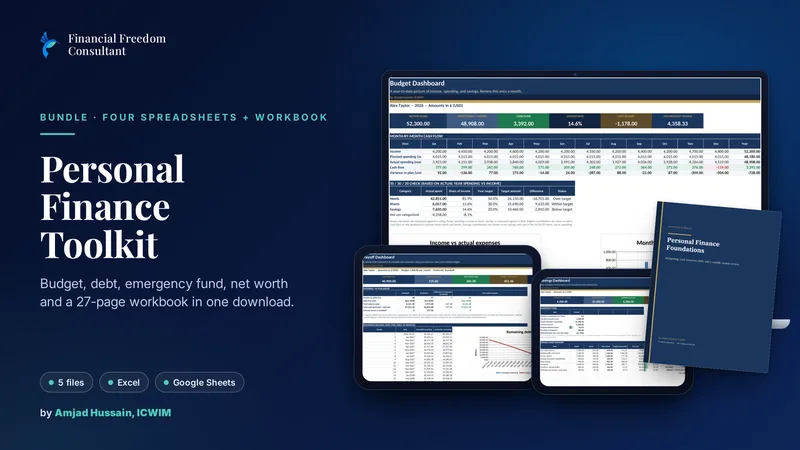 Personal Finance Toolkit Bundle$22.99, instant downloadView →
Frequently asked questions
How much zakat do I pay on shares?
If you hold shares to trade, zakat is 2.5% of their full market value on your zakat date. If you hold them long term, zakat is due on your share of the companies' zakatable assets; when that is hard to find, the National Zakat Foundation (UK) suggests using 25% of market value as a proxy, which means paying 0.625% of the portfolio value.
Is zakat due on ETFs and index funds?
Yes. Apply the same logic as shares: full value if you trade them, or the zakatable share of the underlying holdings (often estimated with a proxy) if you hold them long term. Cash and money-market funds are usually fully zakatable.
What is the nisab for zakat?
The nisab is the minimum wealth before zakat is due: the value of 85 grams of gold or 595 grams of silver. Prices change daily, so enter today's local price per gram. Many zakat bodies use the silver nisab.
Do I pay zakat on my pension or provident fund?
Scholars differ. A common view is to pay on the amount you could access today, after any tax or penalty, while others delay zakat on locked pensions until you receive them. Follow your scholar's guidance.
Can I deduct debts from zakat?
Generally, debts and bills that are due now (or within the coming year, on some views) can be deducted. For a long-term mortgage, many scholars allow only the instalments currently due, not the whole balance.