
HomeLearnZakat on shares, ETFs and funds
Zakat on shares, ETFs and mutual funds
 26 November 2026 · Amjad Hussain, ICWIM · Dubai, UAE
Investing and zakat do mix, but most zakat calculators only ask for one “investments” number. Here is how the main methods work for shares, ETFs and funds, explained simply.
The basics, in one minute
- Zakat is 2.5% of net zakatable wealth held for one lunar year (hawl).
- It is due only if that wealth is at or above the nisab: the value of 85 g of gold or 595 g of silver.
- Zakatable wealth includes cash, gold and silver, trade goods, money owed to you, and investments in the ways explained below.
Why your intention matters
Scholars treat shares differently depending on why you own them:
- Trading (bought to sell for profit): the shares are like trade goods. Zakat is due on their full market value on your zakat date.
- Long-term (for dividends or growth): you own part of a business. Zakat is due on your share of the business’s zakatable assets, such as cash, receivables and stock for sale, not on its buildings, machines or brand.
The proxy methods explained
AAOIFI’s Shari’ah Standard No. 35 on Zakat says that when the exact zakatable assets per share cannot be known, they can be estimated. Two widely used estimates:
| Method | Rate on portfolio value | On 50,000 |
|---|---|---|
| 25% proxy (National Zakat Foundation UK, from its review of FTSE 100 balance sheets) | 0.625% | 312.50 |
| 30% proxy (NZF Canada) | 0.75% | 375 |
| Full market value (trading, or a cautious choice) | 2.5% | 1,250 |
If you can get the zakatable assets per share from a company’s balance sheet or a Shariah-screening service, that is more precise than any proxy.
ETFs, index funds and mutual funds
- Equity ETFs and index funds held long term: treat like long-term shares (proxy or look-through).
- Funds you trade in and out of: full market value.
- Cash, money-market and sukuk funds: mostly zakatable at full value, since they hold cash-like assets.
- Dividends received become cash: include whatever is left on your zakat date.
Pensions, crypto and other questions
- Pensions and provident funds: views differ. Some pay on what they could withdraw today after tax and penalties; others wait until the money is received.
- Crypto: many scholars treat crypto bought for gain like trade goods (full value). Others differ on whether it is permissible at all.
- Interest earned: many scholars say interest should be given away to charity, separately from zakat.
- Debts: debts due now can usually be deducted; for long mortgages, often only the current instalments.
Full worked example
Cash in bank 25,000. Gold 40 g at 300 per gram = 12,000. Long-term ETF portfolio 80,000 using the 25% proxy = 20,000. Trading shares 6,000. Credit card due 4,000.
Net zakatable wealth = 25,000 + 12,000 + 20,000 + 6,000 − 4,000 = 59,000. If this is above the nisab: zakat = 59,000 × 2.5% = 1,475.
Make it easy every year
- Choose one zakat date and keep it (many people use a date in Ramadan; Ramadan 2027 is expected to begin around 8 February).
- Screenshot every account balance on that day.
- Tag each holding as “trading” or “long term” and keep your method consistent.
- Keep it all in one net-worth sheet across currencies.
Tools that make this easier
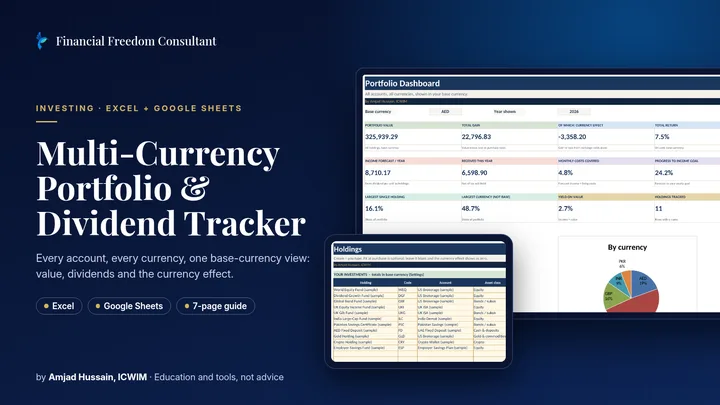 Multi-Currency Portfolio & Dividend Tracker$19, instant downloadView →
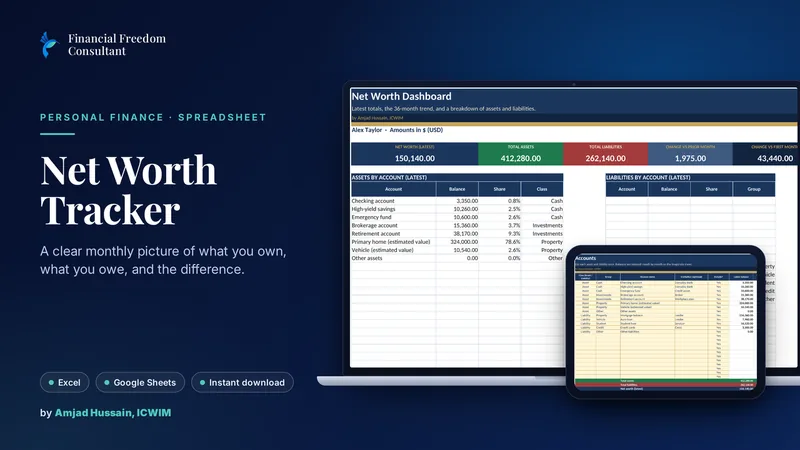 Net Worth Tracker$6.99, instant downloadView →
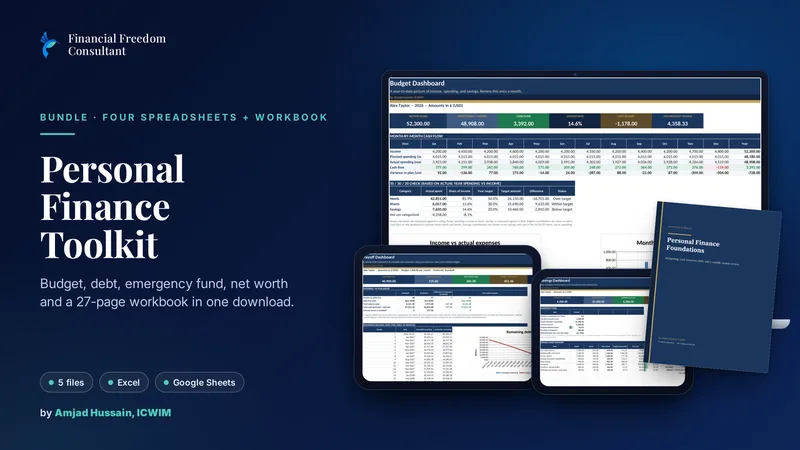 Personal Finance Toolkit Bundle$22.99, instant downloadView →
Frequently asked questions
How do I calculate zakat on shares?
Decide whether you hold them to trade or for the long term. Trading shares: 2.5% of full market value. Long-term shares: 2.5% of your share of the companies' zakatable assets, which many people estimate with a proxy such as 25% of market value (paying 0.625% of the portfolio).
Is zakat due on ETFs?
Yes. Treat an ETF like the assets it holds and the way you hold it: full value if you trade it, or the zakatable share of the underlying companies if you hold it long term. Cash and sukuk ETFs are usually zakatable at close to full value.
What is the 25% proxy for zakat on shares?
It is an estimate from the National Zakat Foundation (UK), based on its study of FTSE 100 balance sheets, that roughly 25% of a listed company's market value represents zakatable assets. You pay 2.5% on 25% of your long-term portfolio.
Do I pay zakat on my pension?
Scholars differ. Some include the amount you could access today after tax and penalties; others pay only once you receive the money. Follow a qualified scholar's guidance.
Do I pay zakat if my shares have fallen in value?
Zakat is based on the value on your zakat date, not what you paid. If the value fell, your zakat on them falls too.
Sources
- National Zakat Foundation (UK): Zakat on stocks and shares
- National Zakat Foundation (UK): Zakat on share investments, determining a proxy
- NZF Canada: Zakat calculator
- AAOIFI Shari’ah Standards
Want a person to check your numbers?
A free 15-minute intro call to see where you stand and what to do next. Education only, no tips, no pressure.
Short form first, so the call is useful for you.
Education only. Not investment, tax, legal or religious advice, and not a recommendation to buy, sell or hold any product. Rules and fees change; always check official sources. By Amjad Hussain, ICWIM (CISI Level 3 International Certificate in Wealth & Investment Management), accredited by the UAE Capital Market Authority, with 10+ years in financial markets. Dubai, UAE.