
HomeLearnRule of 72 and compound interest
The Rule of 72 and compound interest, in plain English
 26 November 2026 · Amjad Hussain, ICWIM · Dubai, UAE
Two ideas explain a great deal about how money grows and how debt hurts: compound interest and the Rule of 72. This guide explains both with simple numbers, shows why starting early matters, and warns about the ways compounding works against you. The figures are examples, not forecasts, and real returns vary and can be negative.
Simple interest vs compound interest
Simple interest is paid only on your original amount. AED 10,000 at 5% simple interest earns AED 500 every year, forever, so after 10 years you have AED 15,000.
Compound interest is paid on your original amount plus the interest already added. The same AED 10,000 at 5% compounded yearly grows to about AED 16,289 after 10 years. The extra AED 1,289 is interest earning interest. The gap looks small at first and then widens, because each year’s growth is calculated on a bigger base.
The Rule of 72
To estimate how long it takes for money to double, divide 72 by the annual rate of growth as a whole number.
| Annual growth rate | Rule of 72 estimate | Exact doubling time |
|---|---|---|
| 3% | 24 years | about 23.4 years |
| 6% | 12 years | about 11.9 years |
| 8% | 9 years | about 9.0 years |
| 12% | 6 years | about 6.1 years |
As you can see, the shortcut is close for ordinary rates. It is less accurate at very high or very low rates. You can also turn it around: if you want to double your money in 10 years, you would need about 7.2% a year, which tells you quickly whether a goal is realistic.
Why time matters more than the rate
Here is what AED 1,000 becomes, with no further deposits, at different yearly growth rates. These are arithmetic examples, not predictions.
| Rate | 10 years | 20 years | 30 years |
|---|---|---|---|
| 3% | AED 1,344 | AED 1,806 | AED 2,427 |
| 5% | AED 1,629 | AED 2,653 | AED 4,322 |
| 7% | AED 1,967 | AED 3,870 | AED 7,612 |
| 9% | AED 2,367 | AED 5,604 | AED 13,268 |
Look at the 7% row. The first 10 years add about AED 967. The next 10 add about AED 1,900. The last 10 add more than AED 3,700. Most of the growth arrives late, which is why time in the market is the factor you control most. Starting 10 years earlier can matter more than finding a slightly higher rate.
Adding money every month
Most people do not invest one lump sum; they save monthly. Suppose you put AED 1,000 a month aside and it grows at 6% a year, compounded monthly, an assumption we use only for illustration.
| Years | You paid in | Value at 6% a year (example) |
|---|---|---|
| 10 | AED 120,000 | about AED 163,900 |
| 20 | AED 240,000 | about AED 462,000 |
After 20 years, more than AED 220,000 of the total would come from growth, not from your deposits, under this assumed rate. Try your own figures in our free SIP calculator, and remember that real markets rise and fall and a return can be zero or negative in any given year.
The same maths works against you on debt
Compounding is just as powerful on money you owe. A credit card balance that charges interest every month can grow quickly if you only pay the minimum. If a debt charges 24% a year, the Rule of 72 says the balance would double in about 3 years if you did nothing. That is why clearing expensive debt is often the first step before investing. See debt snowball vs avalanche for ways to pay it down.
Fees compound too
A fund charging 2% a year instead of 0.5% sounds like a small difference. Over 30 years, with a gross growth of 7% a year, AED 1,000 grows to about AED 4,322 at 2% in fees (5% net) rather than about AED 6,614 at 0.5% in fees (6.5% net), roughly a third less, and the gap widens with larger sums. Costs are one of the few things you can control, so always ask what you pay. Our index fund vs ETF guide compares low-cost options.
Inflation compounds too
Prices rise over time. If prices rise at 3% a year, the Rule of 72 says that what costs AED 100 today would cost about AED 200 in 24 years. Money held in cash that earns less than inflation loses buying power even though the balance looks safe. This is why long-term savings are usually invested for growth, while short-term savings stay in cash. See savings accounts and fixed deposits.
The limits of the Rule of 72
- It is an estimate, not an exact calculation.
- Real investments do not grow in a straight line. Markets can fall sharply before they rise.
- It assumes a steady rate and ignores fees, taxes and inflation unless you subtract them from the rate first.
- A rate used in an example is not a promise. Be wary of anyone who quotes a guaranteed high return.
How to use it
- Check a claim. If someone promises to double your money in two years, that is 36% a year. Ask hard questions and read how scams work.
- Set a goal. Decide how long you have, and see what growth rate it would take.
- Start now. Time is the biggest ingredient. A small monthly amount started early often beats a bigger amount started late.
- Keep costs low and debt short.
- Stay with the plan through market ups and downs.
Practice the mental maths
Try these quickly, then check against the tables above.
- At 4% a year, how long to double? 72 ÷ 4 = 18 years.
- At 9% a year? 72 ÷ 9 = 8 years.
- If something doubles in 6 years, what rate is that? 72 ÷ 6 = 12% a year.
- If prices rise 4% a year, when does AED 100 of buying power halve? About 18 years.
- Money doubling twice takes twice as long, so at 6% about 24 years turns AED 1,000 into roughly AED 4,000.
These little checks help you question any number you are shown. If a figure sounds too good, run the Rule of 72 on it, and you will often see at once how unusual the claim is.
What to do next
Pick one number: how much you can save each month. If you are not sure, read how much to save every month in the UAE. For a structured plan, see the Wealth Builder Bundle below or book a free Fit Call. For a bigger picture of options, visit where can I invest?
Tools that make this easier
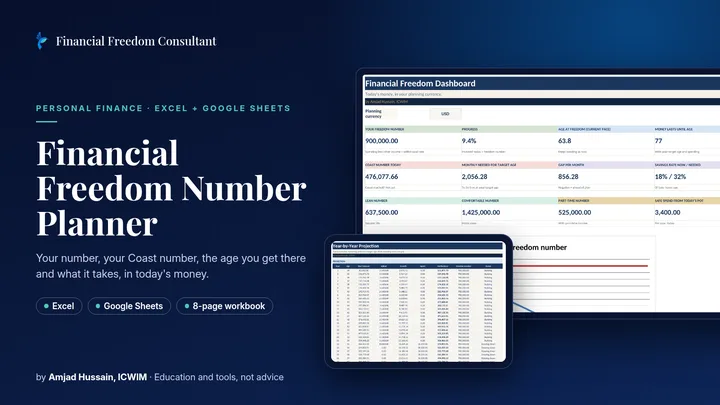 Financial Freedom Number Planner$17, instant downloadView →
 Wealth Builder Bundle: Portfolio Tracker + Freedom Number Planner + 2027 Year-End Money Plan$28.80 until 31 Dec (list $36), instant downloadView →
 Monthly Budget Planner$8.99, instant downloadView →
Frequently asked questions
What is the Rule of 72?
It is a shortcut: divide 72 by the annual growth rate to estimate the years needed to double money. At 6% a year it gives about 12 years.
Is the Rule of 72 accurate?
It is a good estimate for ordinary rates, roughly 4% to 12%. It is less accurate at very low or very high rates, and real returns are not steady.
What is compound interest?
It is interest earned on both your original money and the interest already added, so growth speeds up over time. Debt can compound against you in the same way.
How do I double my money?
There is no safe shortcut. Higher rates usually mean higher risk. Use the Rule of 72 to see what rate and time you would need, and treat promises of fast doubling with caution.
Does inflation affect the Rule of 72?
Yes. If prices rise 3% a year, buying power halves in about 24 years. Subtract inflation from a growth rate to see the real growth.
Are the numbers in this guide forecasts?
No. They are arithmetic examples using assumed rates. Investment returns are not guaranteed and can be negative.
Sources
- U.S. Securities and Exchange Commission: compound interest calculator and explainer (investor.gov)
- Central Bank of the UAE
- UAE Capital Market Authority
Want a person to check your numbers?
A free 15-minute intro call to see where you stand and what to do next. Education only, no tips, no pressure.
Short form first, so the call is useful for you.
Education only. Not investment, tax, legal or religious advice, and not a recommendation to buy, sell or hold any product. Rules and fees change; always check official sources. By Amjad Hussain, ICWIM (CISI Level 3 International Certificate in Wealth & Investment Management), accredited by the UAE Capital Market Authority, with 10+ years in financial markets. Dubai, UAE.